


February 19, 2026
Why Most Enterprise AI Projects Quietly Fail
Most enterprise AI projects fail due to weak governance, poor data strategy, and lack of auditability. Learn how to build compliant, scalable AI systems.
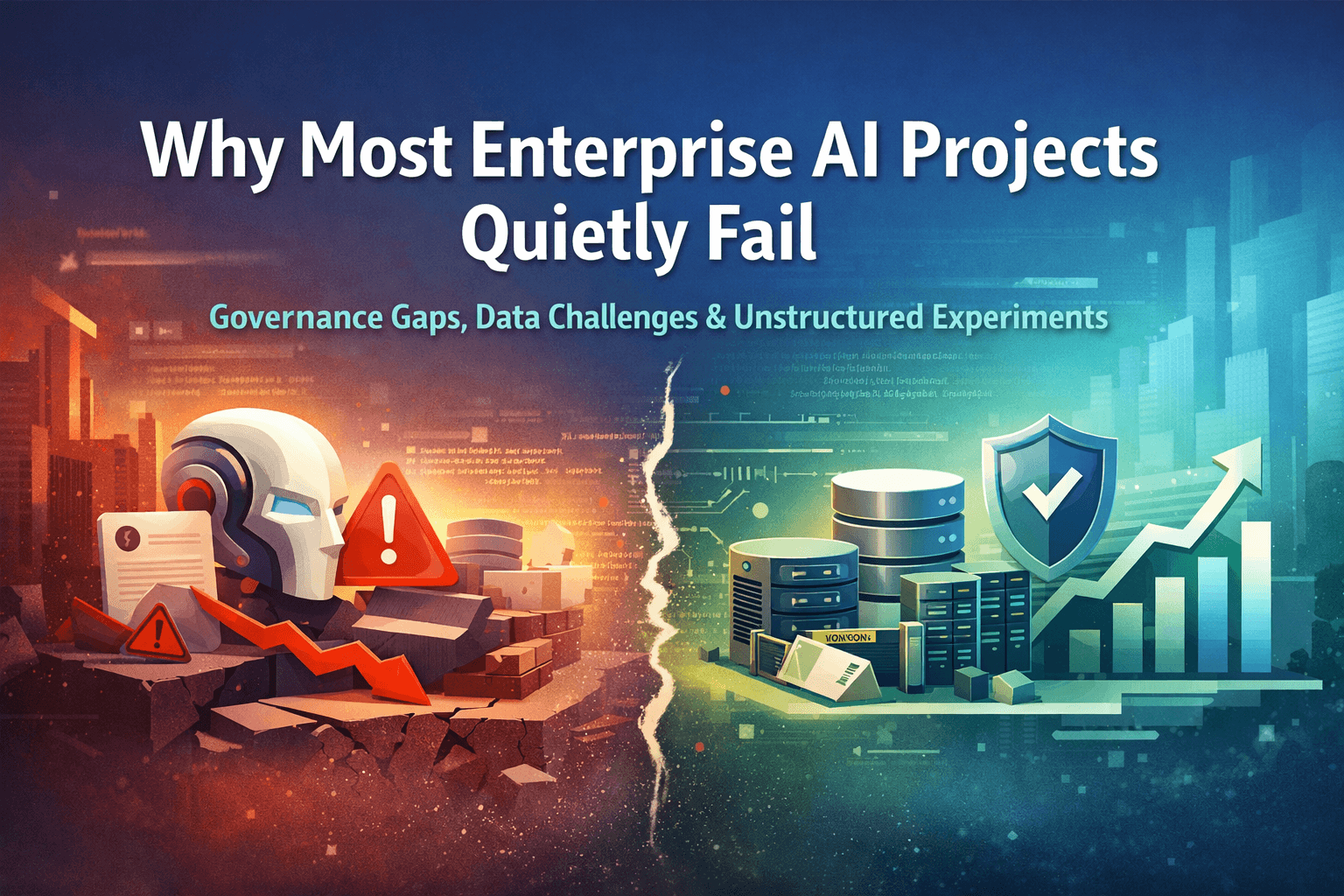
Governance gaps, missing data strategy, and unstructured “internal GPT” experiments are costing organizations more than they realize.
Enterprise AI adoption is accelerating rapidly across industries, as organizations race to integrate artificial intelligence into core business operations. It’s showing up in boardroom conversations, on CTO roadmaps, and inside product teams experimenting with internal copilots and chatbots. Almost every mid-size and large organization is experimenting with some form of enterprise AI implementation.
And yet, if you look a little closer, many of these enterprise AI initiatives fail to scale beyond early-stage pilots. Some stall after the pilot phase. Others underdeliver. A few simply fade away without much discussion.
It is not because the models are weak. Neither because AI lacks capability.
But because the foundational elements of enterprise AI governance and data strategy are missing.
In our research and interaction with mid-size and large organizations, four recurring failure patterns appear consistently:
- Lack of governance
- No structured data strategy
- No auditability
- Internal GPT experiments without architecture
Lack of Governance: AI Without Guardrails
Enterprise AI is not the same as consumer AI.
Regulatory frameworks such as the EU AI Act and GDPR impose strict requirements around enterprise AI governance, accountability, transparency, and risk classification. The EU AI Act introduces risk-based obligations for AI systems and requires documentation, monitoring, and traceability for certain use cases.
Similarly, GDPR requires lawful data processing, purpose limitation, and accountability mechanisms when personal data is involved.
Yet many organizations deploy internal AI tools without:
- Defined ownership
- Risk assessment procedures
- Clear access control policies
- Documentation processes
Without a structured AI governance framework, enterprise AI becomes a compliance and risk liability instead of a productivity multiplier.
Enterprise AI must be deployed as governed digital infrastructure, not as an informal experimental tool.
No Data Strategy: Garbage In, Hallucination Out
Large language models (LLMs) are powerful, yet they cannot replace a well-defined enterprise data architecture.
A common pattern we observe:
- Teams connect an LLM to a shared drive
- Upload thousands of documents
- Expect “instant intelligence”
But enterprises often lack:
- Clean document structures
- Metadata tagging
- Access hierarchies
- Defined knowledge domains
Without structured enterprise RAG systems (Retrieval-Augmented Generation), AI models generate responses probabilistically rather than being grounded in trusted organizational knowledge.
According to research from Stanford’s Center for Research on Foundation Models, grounding LLM outputs in trusted knowledge sources significantly reduces hallucination risks and improves factual reliability.
Enterprise AI requires:
- Curated knowledge ingestion
- Version control
- Document-level permissions
- Continuous data governance
Enterprise AI amplifies the quality of your data strategy; it does not compensate for weak data governance.
No Auditability: The Silent Risk Multiplier
Many internal GPT experiments fail when they face one very basic enterprise question:
“Can we trace how this answer was generated?”
In a quick demo, the output might look impressive. But once the system is evaluated for real-world use, especially in regulated or semi-regulated industries, that question becomes critical. In regulated environments, AI auditability is not optional; it is a core requirement for enterprise AI compliance.
Organizations increasingly require:
- Logged interactions
- Source citations
- User activity tracking
- Role-based access control
- Reproducibility of responses
Frameworks such as SOC 2 and ISO 27001 emphasize logging, monitoring, and access control as core trust pillars.
If an AI system cannot:
- Show where information came from
- Demonstrate who accessed what
- Provide audit trails
…it will not survive procurement review in serious enterprises.
Enterprise AI systems must be explainable, traceable, and fully auditable to meet modern compliance and risk management standards.
“Internal GPT” Experiments Without Structure
This is probably the most common way enterprise AI initiatives go off track.
A motivated team builds something quickly:
- An internal chatbot
- A GPT layer connected to company documents
- A Slack-based AI assistant
The first demo goes well.
People are impressed.
Momentum builds.
But once real usage begins, cracks start to show.
Responses vary depending on who asks. Different departments get conflicting answers. Sensitive documents are surfaced to the wrong audiences. Occasional hallucinations begin to erode trust. And when leadership asks about scaling the system, there’s no clear deployment strategy beyond the original pilot.
Why does this happen?
Because the experiment was never designed as enterprise infrastructure. It lacked:
- A clear architectural blueprint
- Defined governance ownership
- Deployment clarity (SaaS, VPC, or on-prem)
- Formal risk classification
Enterprise AI cannot function as a departmental experiment; it must be treated as organization-wide AI infrastructure.
It must be treated as enterprise AI infrastructure; planned, governed, secured, and deployed with the same rigor as any mission-critical system.
The Pattern Behind the Failures
When we look at enterprise AI initiatives that stall, a clear pattern appears.
The issue usually isn’t the model capability or budget allocation; it’s the absence of a structured enterprise AI implementation framework.

A team built a quick prototype. The demo impressed leadership. Excitement grew. Suddenly, AI became a strategic priority. But somewhere between experimentation and scaling, uncomfortable questions started surfacing:
a) Who owns this system?
b) What data is it accessing?
c) Can we audit its responses?
d) Are we exposed from a compliance standpoint?
That’s when momentum slows. Legal gets involved. Security raises concerns. Procurement asks about certifications. And the once-promising initiative begins to stall.
What Enterprise-Grade AI Actually Requires
Organizations that successfully scale enterprise AI initiatives typically implement:
- A defined AI governance framework
- Role-based access controls
- Structured knowledge ingestion pipelines
- Logging and monitoring mechanisms
- Deployment clarity (cloud, VPC, or on-prem)
- Regulatory awareness from the outset
They treat enterprise AI as a long-term operational and governance layer, not a short-term experimentation tool. This is precisely why enterprise AI solutions must be designed around:
- Compliance readiness
- Auditability
- Infrastructure flexibility
- Measurable ROI
At SparkVerse AI, our approach has always been to build AI knowledge systems with governance and traceability embedded from day one; not retrofitted later. Because retrofitting compliance into AI systems is significantly harder than designing for it upfront.
The Cost of Getting It Wrong
When enterprise AI fails quietly, the cost is rarely public; but it is real:
- Wasted development cycles
- Lost executive confidence
- Regulatory exposure
- Security vulnerabilities
- Slowed digital transformation
More importantly, failed AI pilots create internal skepticism that slows future innovation.
Enterprise AI Must Be Designed, Not Experimented Into Existence
AI is undeniably powerful.
But in an enterprise setting, power without structure doesn’t create advantage; it creates risk.
If you’re exploring enterprise AI seriously, governance has to come first. Not after the pilot. Not after the first compliance concern. From the very beginning.
Before launching another internal GPT experiment, pause and ask:
- Who owns the system?
- How are responses audited?
- What is our regulatory exposure?
- How is access controlled?
- Is our data structured for AI retrieval?
Enterprise AI success is not determined by model sophistication alone, but by how well the system is governed, controlled, and aligned with enterprise risk management.
Final Thought
Organizations that treat AI as infrastructure will lead. Those that treat it as experimentation will stall.
Enterprise AI is no longer just about deploying models; it is about building governed, secure, and scalable systems that align with long-term business strategy.
If you're exploring enterprise AI seriously, enterprise AI governance must come first. That belief is also what guides how we approach enterprise AI systems at SparkVerse AI; designing them as structured infrastructure from day one, not as short-term experiments.
FAQs
What are the main reasons enterprise AI projects fail?
Most enterprise AI projects fail due to weak enterprise AI governance, lack of structured data strategy, absence of auditability, and unstructured internal GPT experiments. Without clear ownership, compliance alignment, and deployment architecture, AI initiatives struggle to scale beyond pilot stages.
What is enterprise AI governance?
Enterprise AI governance refers to the policies, controls, accountability frameworks, and risk management processes that guide how AI systems are developed, deployed, monitored, and audited. It ensures regulatory compliance, data protection, access control, and long-term operational stability.
Why is auditability important in enterprise AI systems?
AI auditability allows organizations to trace how outputs were generated, what data sources were used, and who accessed the system. In regulated environments, audit logs and explainability mechanisms are essential for enterprise AI compliance, risk mitigation, and procurement approval.
How can organizations successfully scale enterprise AI?
Organizations can scale enterprise AI by prioritizing governance first, followed by data strategy, architectural planning, controlled deployment (SaaS, VPC, or on-prem), and continuous optimization. Treating AI as infrastructure, rather than experimentation, enables sustainable adoption.

Written By